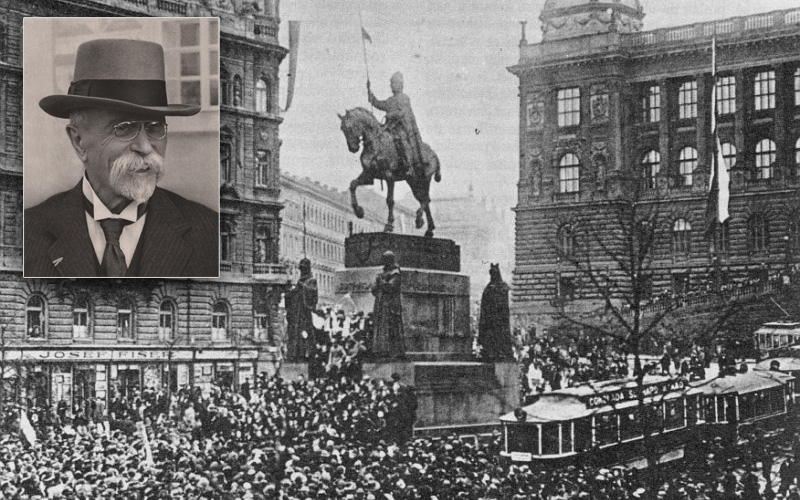
The Day Czechoslovakia Became An Independent Country
On the 28th October every year, the Czech’s have a public holiday to celebrate the formation of a new independent state of Czechoslovakia, which was proclaimed on 28th October 1918 at Wenceslas Square in Prague.
Previous to that, the two nations (Czech and Slovakia) have been part of Austro-Hungarian Empire. They inadvertently became the centre of an action when the First World War started in 1914, and eventually the Bohemian and Moravian fields grew food for the Austro-Hungarian army. The Agricultural Council hid as much supplies as possible to prevent the forced exportation.
In 1916, Tomáš Garrigue Masaryk and Edvard Beneš have formed the National Council, which became the main force behind the anti-Austrian resistance.
Domestic politicians appeared on the scene with the ‘Three King Declaration’ in January 1918.
Early on October 28, 1918, the Agricultural Council put a stop to all transports of grain to the front lines. The National Committee issued the first law on the establishment of an independent state that evening.
Tomáš Garrigue Masaryk became the new president of the state (also known as the ‘First Republic’) and Beneš followed as the second president.
The ‘First Republic’ was one of Europe’s first successful multi-party parliamentary democracies and it soon ranked amongst the top 10 industrialized nations in the world.
Czechoslovakia lasted for 20 years, until the Munich Agreement allowed Nazi’s to legally occupy the Czech Lands in 1938. In 1939 the whole country was under protectorship of Hitler’s Germany.
What followed after that will be covered in another post, where we will shed a light on how the new Czech Republic was born.